Custom storefront design A design service from Turis

We design your storefront.
For your brand, in a week.

Your website was designed. B2B shops usually just get set up. This one gets the same treatment: a complete, custom design of everything your buyers see and use, delivered on your Turis shop and kept current after launch.

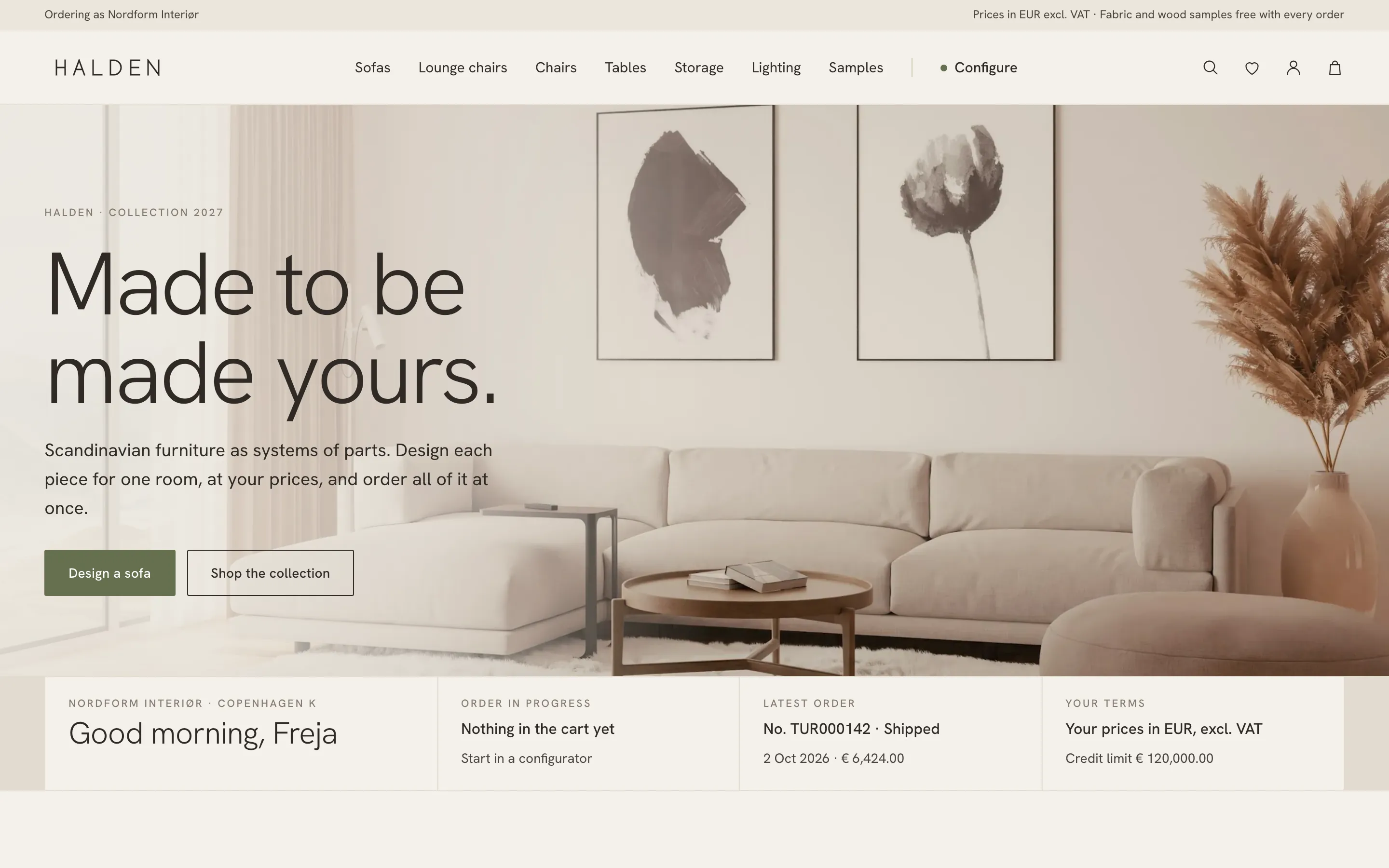
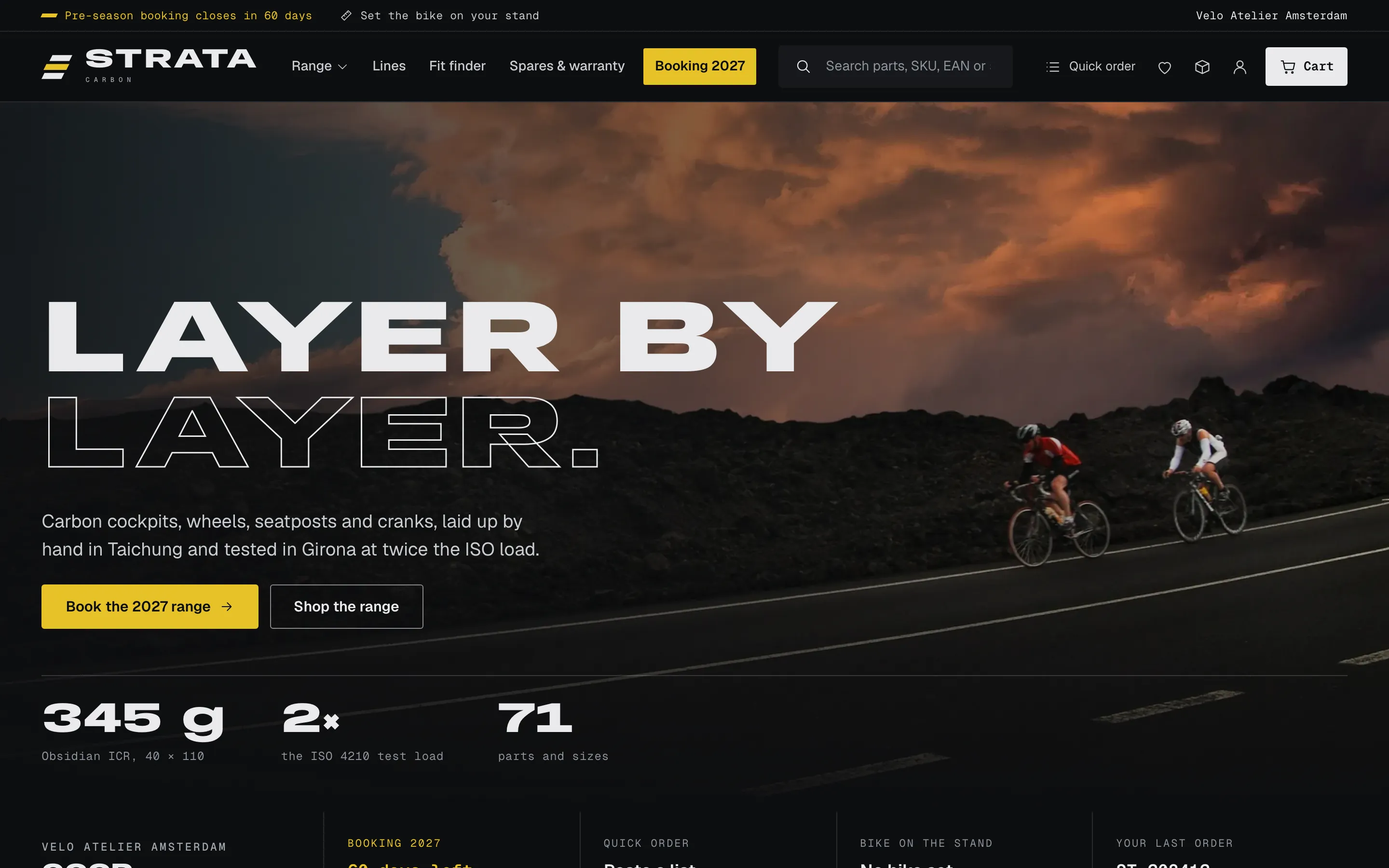
Three of our designs are live on this page. Click any of them.

Halden, Larkfield & Co. and STRATA Carbon. Three fictional brands, three complete designs, the full Turis ordering platform under all of them.

What you get

The look and the functionality, designed as one piece.

Scope of work
  1. 01 · The look

    Every detail looks like your brand.

    Type, colour, spacing, imagery and tone from your website or CVI, at the same visual level, in every corner of the buying experience: home, collection, product, cart, account, and the small moments in between.

  2. 02 · The functionality

    The functionality your sales require.

    We design and build it inside the front: a configurator, a size run, an order sheet with margin, a season booking, a finder. A quantity field is where we start, never where we stop.

  3. 03 · Changes and additions

    It changes as your business changes.

    A brand refresh. A new kind of product that needs its own way of being configured or presented. Something that didn’t work in practice. We change the design. Nothing is locked, and no additional invoice is sent.

Wrapped around the whole Turis platform. The design is what your buyers see and use. Inside it, everything Turis does: customer prices, stock, terms and rules, checkout, every order channel, your ERP. All exactly as they are.

Try the designs

Three demo storefronts. Take the wheel.

We can’t open a customer’s storefront to you, so we built three of our own. Meet Halden, Larkfield & Co. and STRATA Carbon: completely fictional, and between them the breadth of what we can do. Pick one, then click anything.

The functionality we design

When a quantity field is the wrong tool.

A product card with a quantity field is the standard storefront, and for most products the right one. When yours are composed from parts, ordered a hundred lines at a time or booked a season ahead, buying needs a tool of its own. That tool is what we design.

When the product is a system

A sofa, built part by part

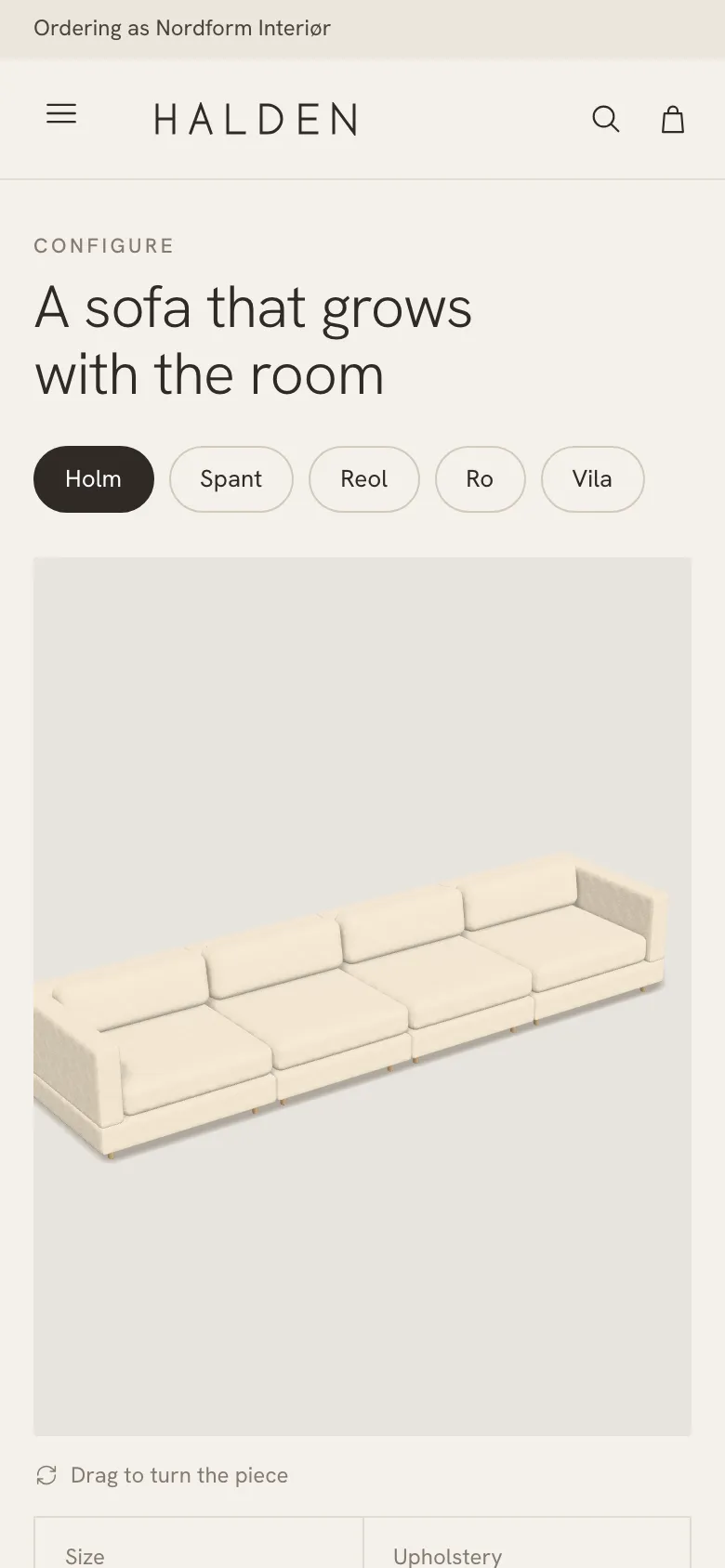
Halden’s buyers don’t order a sofa. They compose one: arms, seats, a corner, a chaise, in a fabric, on a stage they can turn. Every module is a real product at that retailer’s own price, and the finished piece goes into the cart as one batch.

  • Every module priced for the retailer who is looking at it
  • The composed piece added to the cart in one move
  • Tables planned with their leaves, shelving planned bay by bay
  • Contract chairs by the dozen, in a colour grid
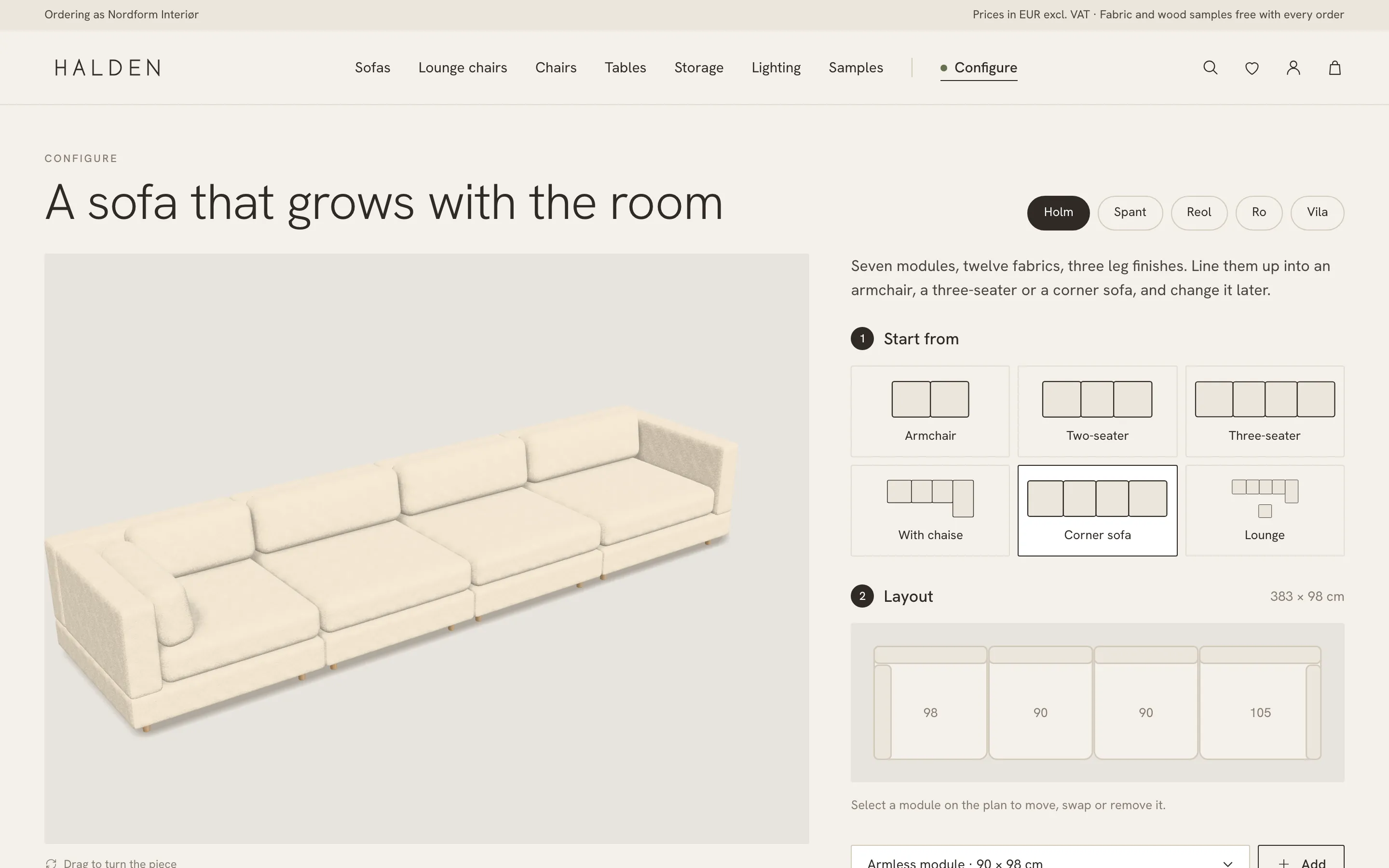
Try it live
halden.turis.app/configure

Halden’s Holm configurator. Seven modules, twelve fabrics, one price per retailer.
When the order is a hundred lines

A spreadsheet that knows the margin

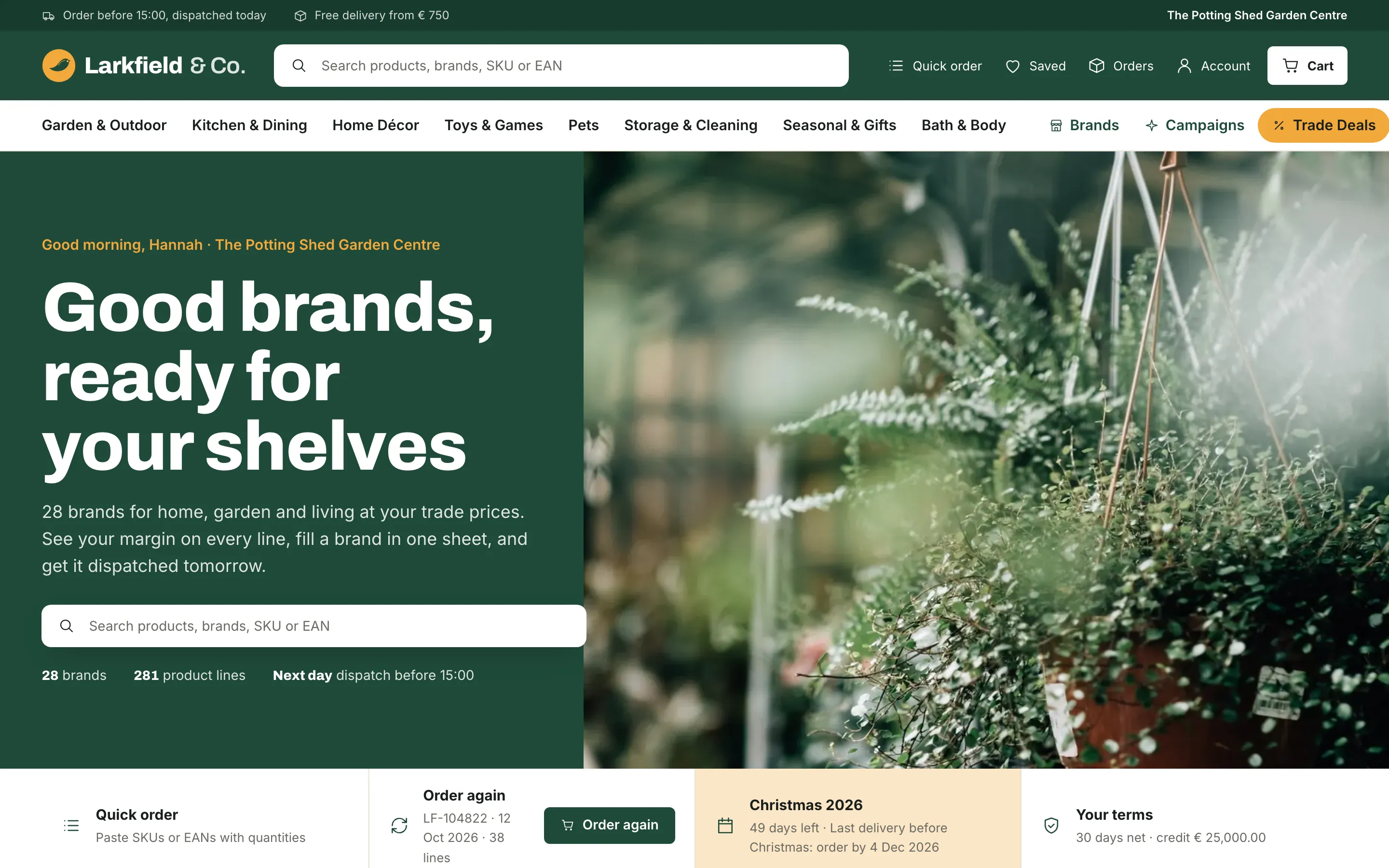
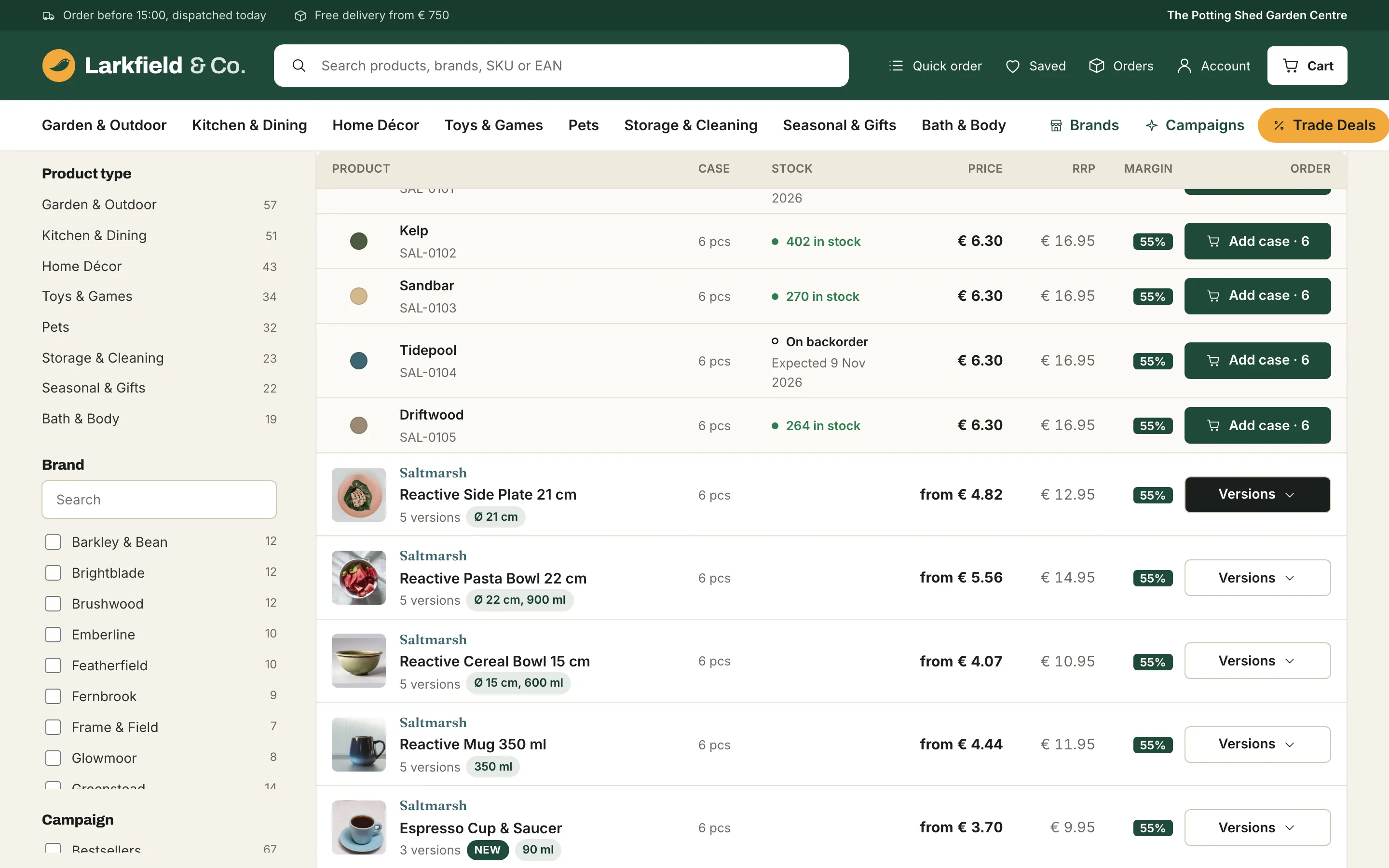
Larkfield’s buyers order by the case, a hundred lines at a time, and every one of them asks the same question: what do I make on it? So the order sheet answers it on every row, next to case size, stock, their price and the RRP.

  • Case, stock, price, RRP and margin on one row
  • A shop per brand that shows how far the order is from that brand’s minimum
  • Campaign pages with a deadline on them
  • Quick order from a pasted list of codes
Try it live
larkfield.turis.app/shop

Larkfield & Co.’s order sheet. The margin column is the reason buyers come back to it.

When the season is sold in advance

Next year, booked this autumn

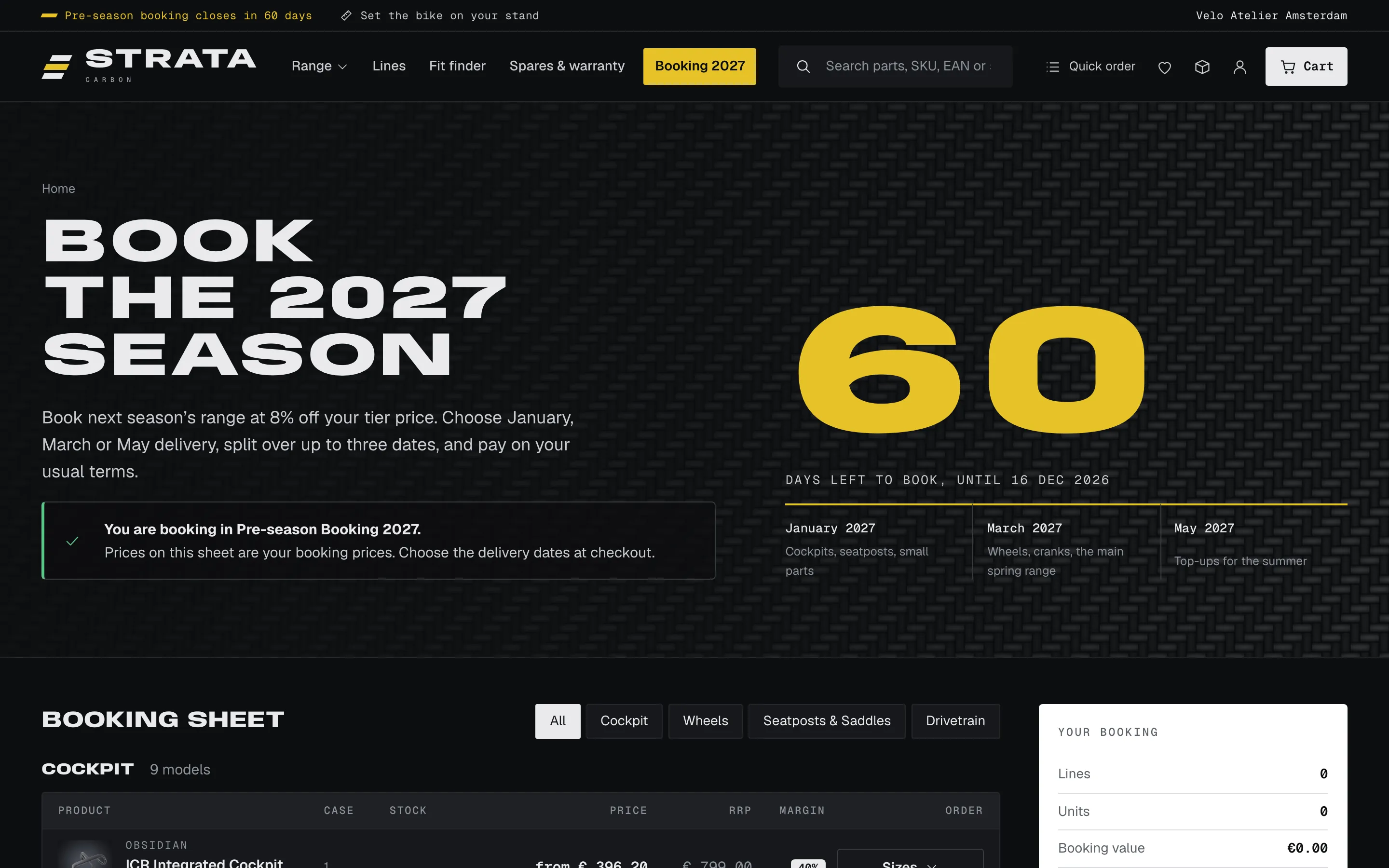
STRATA’s dealers commit to next season months ahead: a countdown to the deadline, three delivery windows, their tier price locked, and the booking’s value growing as the sheet fills. Pre-season booking is a tool in the storefront, not a PDF and a phone call.

  • A countdown, so the deadline sells itself
  • Delivery split across January, March and May
  • Size runs: every size in one grid, with stock per size
  • A fit finder that shows only the parts that fit the customer’s bike
Try it live
strata.turis.app/booking

STRATA Carbon’s booking page. Sixty days to the deadline, three delivery windows, and the dealer’s price locked for the season.

What else we design

Nine kinds of things we designed. Yours could be completely different.

Examples from the three designs above, not a menu. There is no one-size-fits-all version of this job: every industry shows and uses its data differently, and we design what your products, your buyers and your way of selling need.

  • Configurators and planners

    Products composed from parts: modules, bays, options, finishes. Every part a real product at the buyer’s price.

    See Halden’s shelving planner
  • Finders

    Start from what the customer already has, a bike, a machine, a vehicle, a room, and see only what fits it.

    See STRATA’s fit finder
  • Parts by what they fit

    Spares, accessories and consumables found from the product they belong to, by zone and model, the right one on top.

    See STRATA’s spare part finder
  • Grids for sizes, colours and variants

    Every size, colour or length in one grid with stock per cell, added as one batch. Apparel, footwear, furniture, components.

    See Halden’s chairs by the dozen
  • Navigation your buyers think in

    By model and year, by brand, by room, by season, by application: the way your trade browses, rather than your category tree.

    See STRATA’s shop by the bike
  • Brand and range fronts

    A front per brand or per range inside yours, with its own look, its own minimum, and how far the order is from it.

    See Larkfield’s brand shops
  • Seasons, campaigns and deadlines

    Pre-season booking with a countdown and delivery windows. A campaign front with a date on it. Pre-orders by drop.

    See Larkfield’s campaigns
  • Numbers and dates, the way your trade reads them

    Margin for a garden centre, booking value for a dealer, delivery week for a season, distance to a minimum: the figure your buyers decide on, where they decide.

    See Larkfield’s margins
  • Open-to-browse fronts

    The range open at the RRP, editorial and image-led, with sign-in to order: a brand site and a trade shop in one.

    See Halden’s collection

Whatever a tool sends to the cart, the order layer applies that customer’s prices, case rules and limits. A tool can make an order easier to place, never one that breaks a rule.

The design week

Monday, your brand. Friday, your design.

A storefront project is slow because it builds a shop: prices, stock, checkout, integrations, three to six months of it. Your shop already runs on Turis. The week goes on the design, the only part that is new. Time us.

  1. Monday

    We start from your brand.

    Your CVI or design manual if you have one; your website alone is enough to get it on-brand. We ask only what those don’t answer, such as whether we may use your logo, images and fonts.

  2. Tuesday

    You sign off a one-page brief.

    Every design decision from here traces back to it.

  3. Wednesday · Thursday

    We design and build.

    On your Turis shop, against your real catalogue, prices and customers. Not a mock-up: the storefront itself.

  4. Friday

    You open the design on a preview.

    Your products at your prices, on your phone and your desk, seen as one of your own retailers would see it.

  5. Then

    Live on your date, and kept live.

    Buyers keep their logins, carts and order history. After launch the design changes as your business does, and every version can be rolled back in seconds.

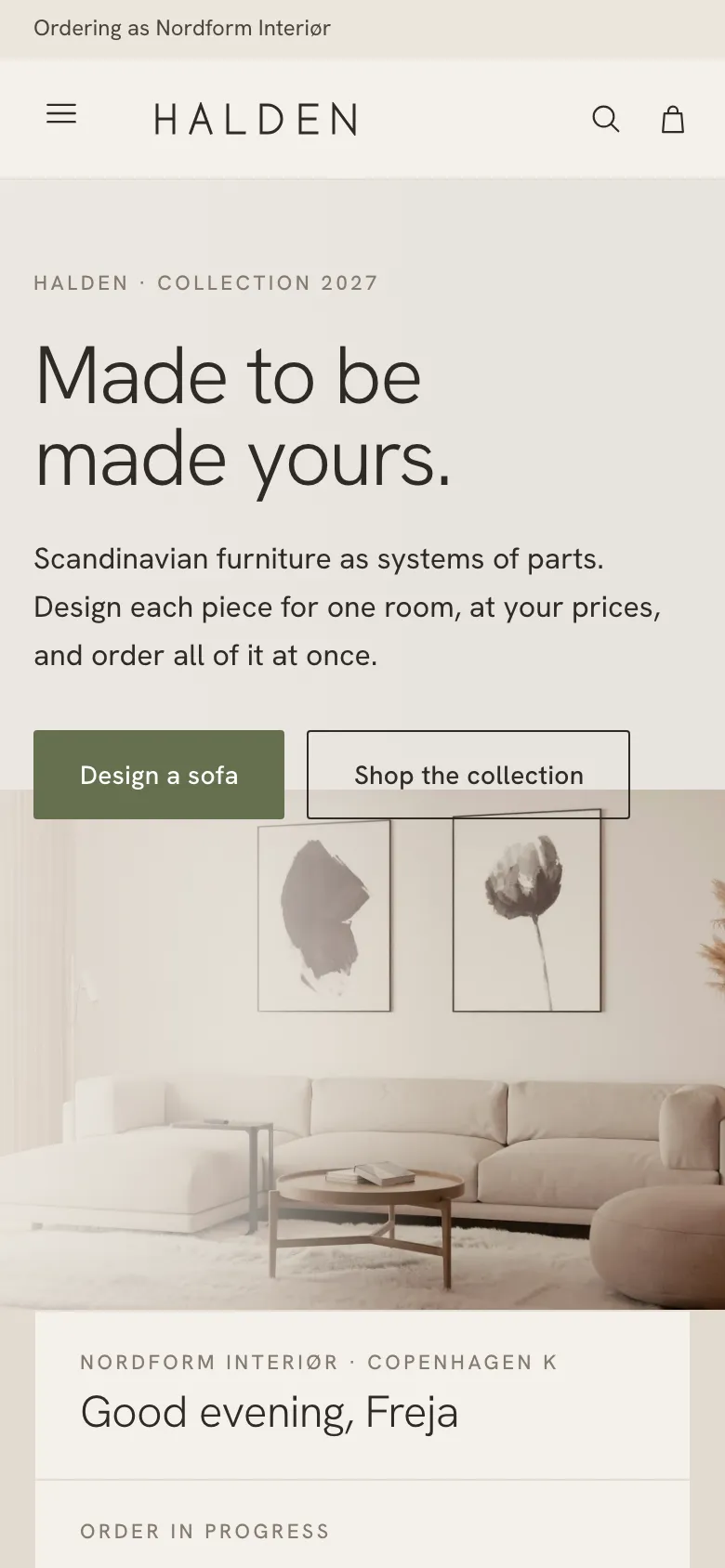
Halden on a phone: the home page with a sofa configurator button and the retailer greeted by name
Halden on a phone: the sofa configurator with a four-module sofa on the stage

What Friday looks like: the design on your phone, with your products.

When to ask for it

Is it for you?

The standard storefront is right when

Buying is straightforward

  • Your buyers know what they want and type it in
  • You sell by the case and the unit from a catalogue
  • Your brand lives in the products more than in the pages
  • You’d rather build the pages yourself, block by block

Custom design is right when

Brand and customisation matter

  • You want a rich, on-brand buying experience with the brand in every detail, as design brands do
  • Selling your products calls for a configurator, a custom presentation or an immersive experience
  • Your catalogue needs its own way of being shown: by brand, by season, by what fits what
  • Buyers need a finder: a part, a model, a fit

Tell us how you sell and we’ll say which you need. Contact us

Questions

The questions that come before the brief

How is this different from the Turis B2B Storefront?

The B2B Storefront is where your retailers sign in and order: your catalogue at their prices, checkout, the order layer, your ERP, with pages you build yourself in the builder. Custom storefront design is a service delivered on top of it: a complete design of the front, the look and the buying flows, kept current after launch. See the B2B Storefront →

A week? Really?

Really. The slow part of a storefront project is the shop: prices, stock, checkout, integrations. On Turis that already runs. The week goes on the design, and on Friday you open it on a private preview with your own products at your own prices.

What about the orders that don’t come through the storefront?

They go through the same order layer. An emailed PDF, an EDI file from a chain or a rep’s order is checked against the same prices, terms and stock, and goes out to the same ERP and the same warehouse. The storefront is one door of four.

Can we build it ourselves?

Not this one. The standard Turis storefront you build yourself, block by block. Custom design is delivered by Turis as a service, on your shop.

What do we need to provide?

Your CVI or design manual if you have one, otherwise your website is enough. Permission to use your logo, images and fonts. And a clear description of how your products are bought. The rest we ask for in a short questionnaire on Monday.

Does checkout change?

It is styled to match the storefront. Its structure and totals stay with the order layer, so what the buyer is charged can never disagree with the order.

Can we change it after launch?

Yes, and it is part of the service. A brand refresh, a new kind of product that needs its own way of being presented, something that didn’t work in practice: we change the design as your business evolves. Nothing is locked, and no additional invoice is sent. Every version can be rolled back in seconds.

We’re already on Turis. Can we get one?

Yes. It is built on your existing shop and switched on when it is ready. Buyers keep their logins and their order history.

Does it work with our ERP and integrations?

Nothing changes underneath. Every integration keeps working as it does today, and the orders arrive in the ERP exactly as they do now.

Send us your website. See your design in a week.

A link, a few lines on how your products are bought, and if you have one, a real order. A messy one, ideally. The design comes back in a week; the order goes through Turis while you watch.