
B2B Order Management Software: The 2026 Guide
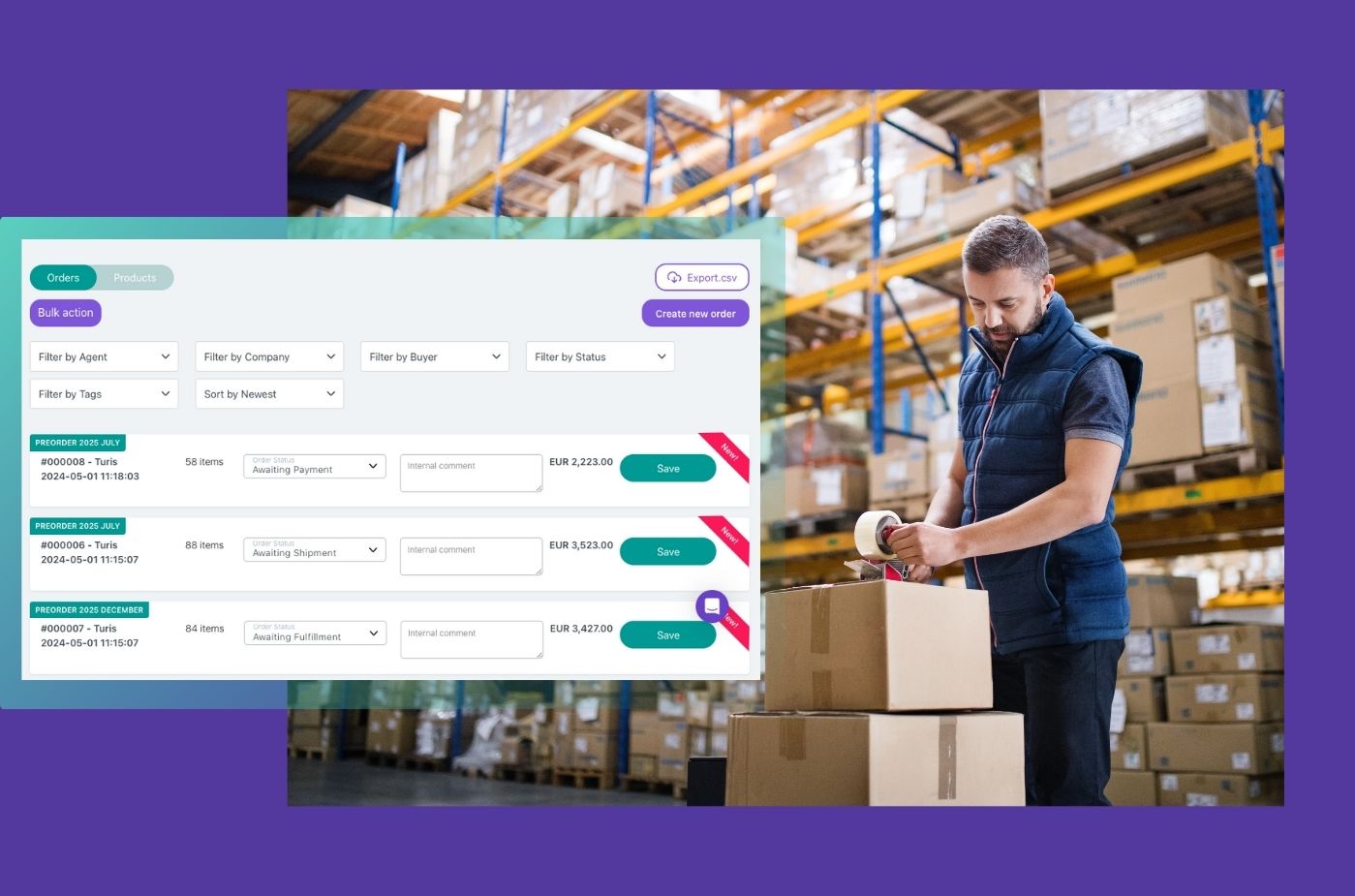
Updated June 2026 · In one sentence
B2B order management software is the system that captures, validates and processes business-to-business orders — pricing them per account, routing them to fulfilment, and syncing them into your ERP. In 2026, the best B2B OMS isn’t just a webshop — it’s a multi-channel order capture layer that turns every inbound order (webshop, EDI, email, PDF) into structured data flowing into the back office.
What is B2B order management software?
B2B order management software (often shortened to B2B OMS, or called a B2B order management system) is the software that sits between your customers’ orders and your fulfilment operation. Its core job: take any inbound order from a business customer, apply the right pricing, validate against credit and inventory, and route it as a structured sales order to whichever system fulfils it — usually an ERP.
Put another way: it’s the layer that stops your sales team from manually retyping orders into the ERP. Every B2B operation eventually hits this problem — orders arrive from many channels, in many formats, and someone has to translate them into something the back office understands. B2B order management software is that translator, automated.
The category goes by several names depending on who’s describing it. Order processing software, sales order management system, B2B order taking software, and order management platform are all roughly the same thing — software that handles the lifecycle of a B2B order from intake to fulfilment. Some platforms emphasise the inventory side and call themselves order and inventory management; others emphasise the customer-portal side and call themselves B2B ecommerce. The category is broader than any one of those labels.
How did B2B order management change by 2026?
For most of the last decade, B2B order management meant one thing: build a webshop. The thinking was that if you gave your customers a self-serve portal, they’d log in and place their orders themselves, and the order desk could shrink. It was the same playbook that B2C ecommerce had been running for 20 years.
The thinking wasn’t wrong. The B2B webshop is still a cornerstone of modern order management — it just turned out to not be enough. Here’s the reality most B2B teams discovered around 2023–2025: even with a working webshop, 30 to 80 percent of orders still arrived through other channels. The biggest customers used EDI. Procurement-driven accounts emailed PDFs. Long-tail customers sent spreadsheets. Some called and dictated orders to a sales rep.
And those non-webshop orders were, almost without exception, getting retyped by hand into the ERP. The order desk hadn’t shrunk. It had just gained a portal to manage on top of everything else.
So by 2026, the definition of “good” B2B order management software has shifted. The category isn’t just “a webshop with an ERP integration” anymore. The best B2B order management platforms in 2026 are multi-channel order capture layers — software that turns every inbound order into a structured sales order, no matter how it arrived:
- The webshop still handles the customers who’ll self-serve — SMB accounts, repeat orderers, customers who prefer a portal.
- AI-driven order capture handles email orders, PDF attachments, Excel sheets — the orders that arrive in human-written formats. The AI reads them, structures them, and submits them to the same fulfilment pipeline as the webshop.
- Native EDI handles the procurement-driven accounts — the major retail chains, wholesalers, and corporate accounts whose buying systems aren’t going to change.
- API + manual entry handle the edge cases — phone orders captured by a rep, custom integrations to long-tail systems.
The point isn’t to force every customer onto one channel. It’s to accept that customers will buy how they want to buy — and to capture every order into the same structured pipeline anyway. This is the shift that defines B2B order management in 2026.
What does B2B order management software actually do?
The capabilities of a real B2B order management system fall into six areas. A platform that handles all six well covers what most B2B businesses need; one that handles only the first two or three usually shifts work to the order desk rather than eliminating it.
1. Order capture across every channel
Capturing orders from the webshop is table stakes. The differentiator in 2026 is what happens to the orders that arrive elsewhere — email, PDF, Excel, EDI, phone. A modern B2B OMS turns all of them into structured data automatically, so the same downstream pipeline serves every order regardless of source.
2. Customer-specific pricing and catalogues
Two customers ordering the same SKU pay different prices in B2B. Per-account price lists, contract pricing, volume tiers, currency overrides, and customer-specific catalogues are all native concepts. The software should apply the right pricing automatically — not require the order desk to look it up.
3. Order validation and approval flows
MOQs, case-pack rounding, credit limits, available stock, customer-specific SKU restrictions — every B2B order needs to be validated against a stack of rules before it’s released to fulfilment. Approval flows handle the cases where the order needs a manager’s sign-off (typically over a threshold, or where credit is constrained). Modern B2B OMS handles these automatically; older systems push them to the order desk.
4. ERP and accounting integration
The whole point of the OMS is to feed the back office. So orders sync into the ERP as structured sales orders, customers and pricing flow back from the ERP, and stock and lead-time information stays current in both directions. Look for pre-built integrations with your specific ERP (Business Central, NetSuite, SAP Business One, Acumatica, Odoo, etc.) rather than partner-built bridges — the partner-built ones tend to be expensive to maintain over years.
5. Fulfilment routing and shipping integration
Multi-warehouse routing logic, integration with shipping providers, and label generation are where the OMS hands the order to the physical fulfilment process. For businesses with a single warehouse and a 3PL, this is light. For multi-region operations with multiple warehouses, it’s where a lot of complexity lives.
6. Reporting, signals, and customer activation
The OMS sees every order — which means it sees customer behaviour, drop-offs, reorder cycles, and growth patterns. Modern B2B OMS platforms turn this into operational signals: which customers haven’t ordered in 60 days, which SKUs are accelerating, where margin is leaking. The best platforms also automate the response — reminder emails, restock prompts, win-back campaigns — without requiring a separate marketing tool.
What’s the difference between a B2B OMS, an ERP, and a B2C webshop?
The B2B order management category sits between several adjacent systems, and the boundaries get blurry. The clearest way to think about it:
| System | What it does | What it doesn’t do |
|---|---|---|
| B2B order management software | Captures orders from every channel, validates and prices them, routes them to fulfilment, syncs to ERP. | Not the system of record for finances, inventory ownership, or accounting. |
| ERP | System of record for everything operational — finance, inventory, fulfilment, accounting. | Usually not customer-facing. Not built for capturing orders from external channels. |
| CRM | Manages the sales pipeline and customer relationship data — conversations, deals, account info. | Doesn’t process or fulfil transactions. |
| B2C webshop platform (Shopify, BigCommerce) | Storefront optimised for anonymous consumer shoppers with one price for everyone. | Doesn’t handle customer-specific pricing, EDI, complex approval flows, or non-webshop channels natively. |
| B2B inventory management software | Tracks stock across locations and updates availability. | Usually doesn’t capture orders or handle customer-facing pricing. |
A real B2B order management platform in 2026 sits in front of the ERP and behind the customer. It’s the layer that turns inbound order chaos into a clean sales-order pipeline. The ERP is the system of record; the OMS is the system of capture.
How do you choose B2B order management software?
The market has dozens of options labelled “B2B order management software”. Most are one of three things: a B2C platform with B2B plugins bolted on, a legacy ERP module that hasn’t been touched in a decade, or a modern multi-channel platform built for B2B from the ground up. The criteria below cut through the marketing language.
- Multi-channel capture is native. Webshop alone is not enough in 2026. If the platform can’t capture orders from email/PDF/Excel and EDI as first-class channels — not as “coming soon” or “via a partner integration” — you’re looking at an incomplete OMS.
- Customer-specific pricing is configured, not coded. Per-account price lists, contract pricing, volume tiers should all be admin-level configuration. If they require developer hours per change, you’re shifting work, not eliminating it.
- ERP integration is pre-built and maintained. Native integration with your specific ERP (Business Central, NetSuite, SAP, Acumatica, Odoo, etc.) maintained by the platform team. Not a partner SOW. Not a Zapier scenario.
- Approval flows handle real B2B procurement. Multi-buyer accounts with sub-user roles, budget-cap approvals, manager sign-offs. If a customer’s procurement requires three people to release an order, the OMS should model that — not require the customer to share a single login.
- Implementation is platform-led, not partner-led. The team that builds the platform should also implement it. Partner-led implementations introduce a queue, change-order ceremony, and pricing that tends to grow with scope.
- Go-live is measured in weeks, not quarters. A modern B2B OMS for a standard operation should be configurable to first real customer in under eight weeks. Custom-development timelines (six to eighteen months) signal an underbuilt platform with a lot of bespoke work happening per customer.
- Pricing is published. A platform that won’t show you its pricing without a gated demo usually means the pricing is variable based on what they think you’ll pay. Published pricing is a signal of confidence and consistency.
- The roadmap is visible. Public changelogs, release notes, weekly shipping cadence — signals that the platform is actively being developed. Static platforms are technical debt waiting to be repriced as “legacy” in three years.
If a platform handles the first four well but treats the multi-channel and modern-implementation criteria as nice-to-haves, you’re evaluating a B2C webshop with a B2B skin. That works for small wholesale operations; it stops scaling somewhere between the tenth and fiftieth account.
What does B2B order management look like in practice?
For a concrete example of how a 2026 B2B order management approach plays out, take Turis customer To Øl — a craft brewery in Copenhagen that ships into 50+ countries. Before Turis, every order was retyped into SAP by a sales rep, regardless of how it arrived. Sales reps were spending half the day on data entry.
With multi-channel order management in place:
- The webshop handles the smaller on-trade accounts — the bars, cafés, hotels that’ll log in and order themselves.
- Vision (the AI capture layer) reads the emailed PDFs and Excel orders, structures them, and submits them to the same pipeline as the webshop.
- Native EDI handles the major Danish retail chains — Coop, Dagrofa, Salling Group — whose procurement systems were never going to change to a portal.
The result: 90 percent of orders now arrive structured directly from customers, with the order desk only handling exceptions. Sales reps got about 20 hours per week back. The team saved one full-time-equivalent in administrative time without reducing headcount — the people who were retyping orders are now spending time with customers instead.
This is what good B2B order management looks like operationally. It’s not the storefront alone; it’s the storefront plus every other channel, captured into the same pipeline. Read the full To Øl story here.
How does Turis fit?
Turis is a B2B order management platform built around the multi-channel reality described above. Started in 2018 in Copenhagen as a B2B webshop, Turis evolved into an integrated order layer that handles every channel:
- B2B Storefront — The self-serve portal for the customers who’ll use one. Customer-specific pricing, MOQs, credit terms, approval flows, all native.
- Vision — AI that reads emailed PDFs, Excel sheets, and unstructured orders and turns them into structured sales orders automatically.
- EDI — Native EDI handling for the procurement-driven accounts. No partner middleware.
- Integrations — Pre-built ERP and accounting integrations across Business Central, NetSuite, SAP, Acumatica, Odoo, and more.
200+ B2B brands across 30+ countries run their order operations on Turis. The platform is turnkey — configured to your setup, deployed in weeks rather than months. Pricing is published. Implementation is run by the Turis team in Copenhagen, not a partner network.
Frequently asked questions
What’s the difference between B2B order management software and a B2B webshop?
A B2B webshop is one channel a B2B order management system can handle — the self-serve portal where customers log in. A B2B order management platform handles orders from every channel, including the ones that arrive outside the webshop (email, PDF, EDI, phone). In 2026, B2B OMS is the superset; the webshop is one feature within it.
What’s the difference between order management software and an ERP?
The ERP is your system of record — finance, inventory, fulfilment, accounting. The B2B order management software sits in front of the ERP, capturing orders from external channels and submitting them as structured sales orders. The ERP doesn’t usually capture orders well; the OMS doesn’t replace the ERP. They’re complementary.
Can I use Shopify or BigCommerce as my B2B order management software?
For small wholesale operations with simple pricing, yes — with the right plugins or add-ons. For mid-to-large B2B with customer-specific pricing, credit terms, multi-buyer accounts, EDI requirements, and real ERP integration, B2C platforms tend to require enough workarounds that a dedicated B2B OMS pays back the cost difference within the first year. The biggest gap on B2C platforms is multi-channel capture — they handle the webshop but not the EDI, email, and PDF orders that arrive outside it.
What’s “sales order management” vs “order management”?
Same category. “Sales order management” emphasises the part of the process that creates the formal sales order document for fulfilment and invoicing. “Order management” is the broader term covering capture, validation, routing and fulfilment. Software vendors use both labels interchangeably.
What is web-based order processing software?
The same category as B2B order management software, with a slight emphasis on the cloud / web-delivered nature. Almost every modern B2B OMS is web-based by default in 2026 — on-premise platforms still exist but they’re increasingly rare for new implementations.
How long does it take to implement B2B order management software?
Realistic timelines range from six weeks to nine months. The biggest variable is whether the implementation is configuration (most modern turnkey platforms) or custom development (legacy platforms or projects-led vendors). Turnkey, configuration-led platforms typically reach first-real-customer go-live in under eight weeks. Custom-development projects often miss the original quarter and bleed into the next one.
How much does B2B order management software cost?
Pricing varies by volume, modules, and integration complexity. Entry-level B2B OMS platforms (often B2C platforms with B2B add-ons) typically start under €1,000/month but accumulate costs in plugins, partner development, and operational overhead. Dedicated turnkey B2B OMS platforms usually start higher but bundle the mechanics natively. See Turis pricing for a worked example.
Do I need B2B inventory management software too?
Most modern B2B OMS platforms include inventory awareness — stock levels, multi-warehouse routing, availability checks at order capture — without needing a separate inventory management product. Your ERP is the system of record for inventory; the OMS reads from it. Where you’d want dedicated inventory management software is for warehouse-level operations (bin locations, pick paths, cycle counting) that an OMS doesn’t cover.
Where to go next
- See the longer guide on B2B storefronts — what they are and how to choose one.
- Read how multi-channel ordering works in practice across storefront, Vision, and EDI.
- Compare Turis vs Shopify Plus for B2B specifically.
- See Turis pricing.
- Book a 30-minute call — we’ll show you how Turis would fit your channel mix.
